
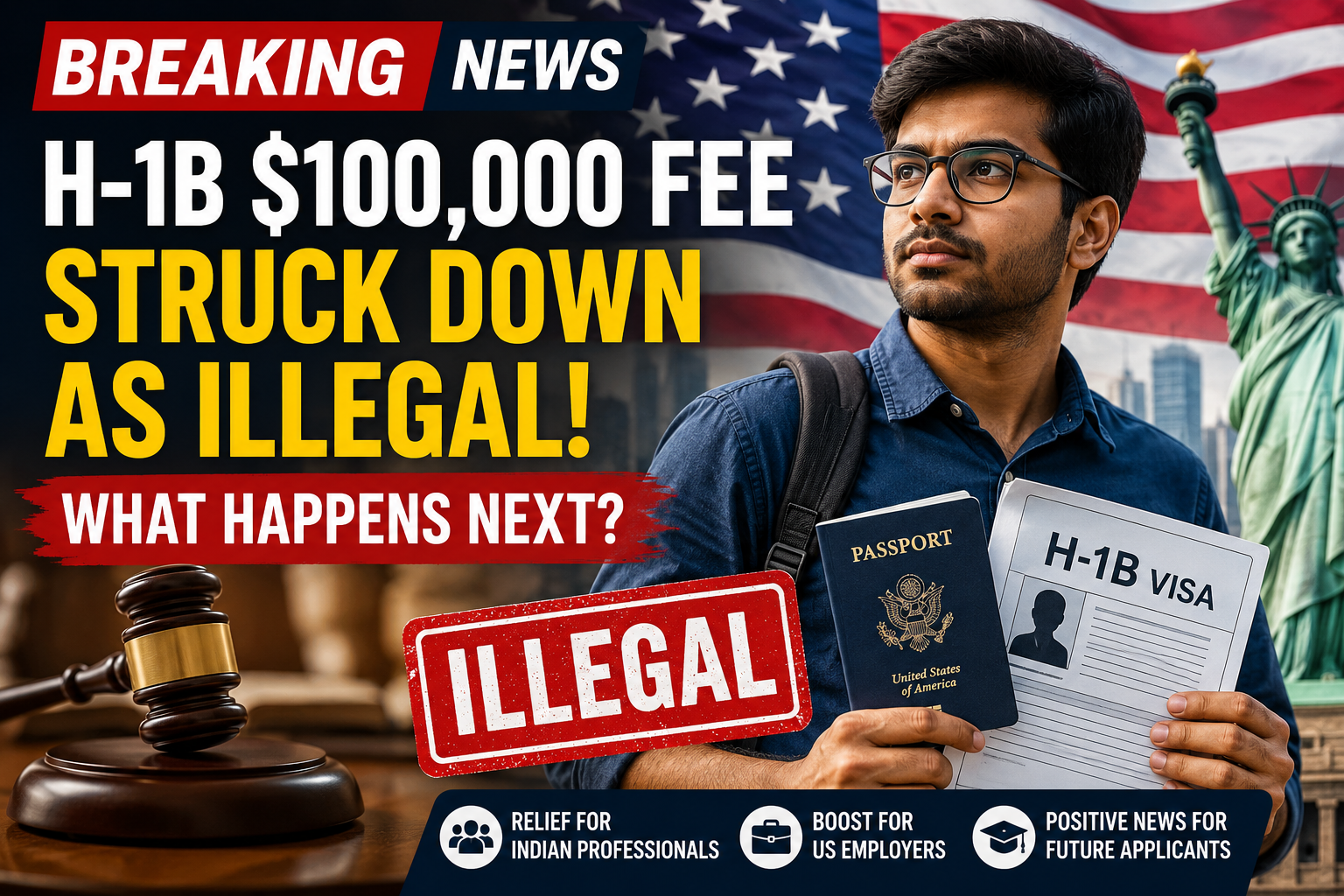
H-1B $100,000 Fee Struck Down as Illegal: What It Means for Indian Professionals in 2026
In a major development for skilled foreign workers and employers across the United States, a federal judge has declared the controversial $100,000 H-1B visa fee unlawful. The ruling is being viewed as a significant victory for businesses, technology companies, immigration advocates, and thousands of Indian professionals who depend on the H-1B visa program to work in the United States.
The decision comes after months of debate surrounding the dramatic fee increase introduced in 2025. The fee was intended to make H-1B visas more expensive and reduce dependence on foreign workers. However, critics argued that the policy would create unnecessary barriers for employers and skilled professionals.
With the court now invalidating the fee, many applicants and companies are asking the same question: What happens next?
What Was the $100,000 H-1B Visa Fee?
In September 2025, the Trump administration announced a new policy requiring employers to pay a fee of $100,000 for certain new H-1B visa applications.
The H-1B visa is one of the most popular employment visas in the United States and allows employers to hire highly skilled foreign professionals in fields such as:
- Information Technology
- Engineering
- Artificial Intelligence
- Healthcare
- Finance
- Scientific Research
Traditionally, H-1B application costs were significantly lower. The introduction of a $100,000 fee represented one of the largest increases in the history of the program.
Supporters argued that the measure would encourage companies to hire more American workers. Critics believed it would damage innovation, reduce competitiveness, and create serious challenges for employers seeking specialized talent.
Why Did the Judge Strike Down the Fee?
A federal court ruled that the $100,000 fee exceeded the authority granted to the executive branch.
According to the ruling, the fee functioned more like a tax than a standard immigration fee. The court concluded that only Congress has the authority to impose such a significant financial requirement.
The judge stated that the administration did not have legal authority to introduce the fee through executive action alone.
As a result, the court ordered that the fee be invalidated and blocked from enforcement.
Who Challenged the Policy?
The case was brought by a coalition of Democratic-led states that argued the fee would harm employers, educational institutions, healthcare systems, and public services that rely on skilled foreign workers.
The plaintiffs claimed the fee would:
- Increase hiring costs dramatically
- Reduce access to global talent
- Harm economic growth
- Impact innovation and research
- Create staffing shortages in critical sectors
The court ultimately agreed that the administration had exceeded its authority in implementing the measure.
Why Is This Important for Indian Professionals?
India remains the largest beneficiary of the H-1B visa program.
Every year, thousands of Indian professionals receive H-1B visas and work in the United States across industries such as:
- Software Development
- Cloud Computing
- Cybersecurity
- Artificial Intelligence
- Data Science
- Engineering
- Healthcare
A $100,000 visa fee would have significantly reduced the willingness of many employers to sponsor foreign workers.
For Indian professionals, the court’s decision removes a major obstacle that could have limited future employment opportunities in the United States.
Impact on US Employers
Many American companies strongly opposed the fee.
Technology firms, startups, universities, healthcare providers, and research institutions argued that the measure would make it difficult to recruit specialized talent.
The ruling provides relief for employers that rely on skilled international professionals to fill critical positions.
Businesses can now continue planning future recruitment without the burden of an additional $100,000 cost per visa application.
What Happens Next?
Although the fee has been struck down, the story is not necessarily over.
The administration still has legal options available, including:
Appeal the Decision
Government lawyers may challenge the ruling in a higher court.
If an appeal is filed, additional legal proceedings could follow.
Request a Stay
Officials may attempt to temporarily pause the ruling while appeals are considered.
Pursue Alternative Policies
Future administrations or lawmakers may explore different approaches to reforming the H-1B program.
For now, however, the court ruling means the $100,000 fee cannot be enforced.
What Does This Mean for Future H-1B Applicants?
Current and future applicants may view the decision as positive news.
The ruling:
- Reduces uncertainty
- Removes a major financial barrier
- Supports employer sponsorship
- Helps maintain access to global opportunities
However, applicants should continue monitoring immigration updates because policies can change quickly.
Impact on International Students
The decision is also important for international students studying in the United States.
Many students choose American universities with long-term career goals that include:
- OPT (Optional Practical Training)
- H-1B sponsorship
- Long-term employment
- Potential permanent residency pathways
A $100,000 H-1B fee could have reduced sponsorship opportunities after graduation.
The court’s ruling helps preserve a more accessible pathway for students planning careers in the United States.
Global Competition for Talent
Countries around the world are competing aggressively for highly skilled workers.
Canada, Australia, the United Kingdom, and several European nations continue to introduce policies designed to attract international talent.
The United States remains a leading destination, but immigration policies play a major role in determining whether employers can successfully recruit global professionals.
Many experts believe maintaining access to skilled workers is essential for innovation, technology development, healthcare, and economic growth.
What Should Indian Students and Professionals Do?
This ruling is encouraging, but long-term success still depends on careful planning.
Students and professionals should:
- Stay informed about immigration updates
- Develop in-demand skills
- Maintain strong academic and professional profiles
- Explore multiple international opportunities
- Seek professional guidance before making major decisions
The global job market continues to evolve, and flexibility remains important.
How Career Makers Education Can Help
At Career Makers Education Ahmedabad, we help students and professionals stay informed about the latest international education and immigration developments.
Our services include:
- Study abroad counselling
- Student visa guidance
- University admissions
- IELTS coaching
- PTE coaching
- SOP preparation
- Career planning support
We help individuals identify the best opportunities for education, employment, and international career growth.
Final Thoughts
The federal court’s decision to strike down the $100,000 H-1B visa fee is being viewed as a major victory for skilled foreign workers, employers, and educational institutions.
For Indian professionals, the ruling removes a significant barrier that could have limited future opportunities in the United States.
While further legal challenges may still occur, the decision provides immediate relief and reinforces the importance of lawful immigration policymaking.
As the global competition for skilled talent continues, staying informed about immigration developments will remain essential for anyone planning an international career.